International growth often begins by taking technology beyond familiar settings and testing it together with the right partners.
For 10 Danish companies working within water and environmental technology, international innovation pilots have created exactly that opportunity. Across the Netherlands, China, Sweden, Norway, Germany and other markets, technologies have been developed, tested and connected with new collaboration partners.
The projects cover a wide range of solutions: from cameras that transfer a well-known agricultural method to underwater monitoring, to CO₂-based textile recycling and an industrial laser robot that has attracted interest from some of the world’s largest players in the wind industry.
From fields to the seabed: Anemo Robotics takes NDVI underwater
NDVI is a well-established method for monitoring plant health and development on land. Anemo Robotics is now working to bring the same principle below the water’s surface.
NDVI is a well-established method for monitoring plant health and development on land. Anemo Robotics is now working to bring the same principle below the water’s surface.
Together with the Dutch research institute NIOZ, the company is developing AnemoCam – an underwater camera combining standard RGB imaging with near-infrared technology. The aim is to enable long-term monitoring of developments in, among other things, seagrass and seaweed, creating continuous data series rather than isolated snapshots of the marine environment.
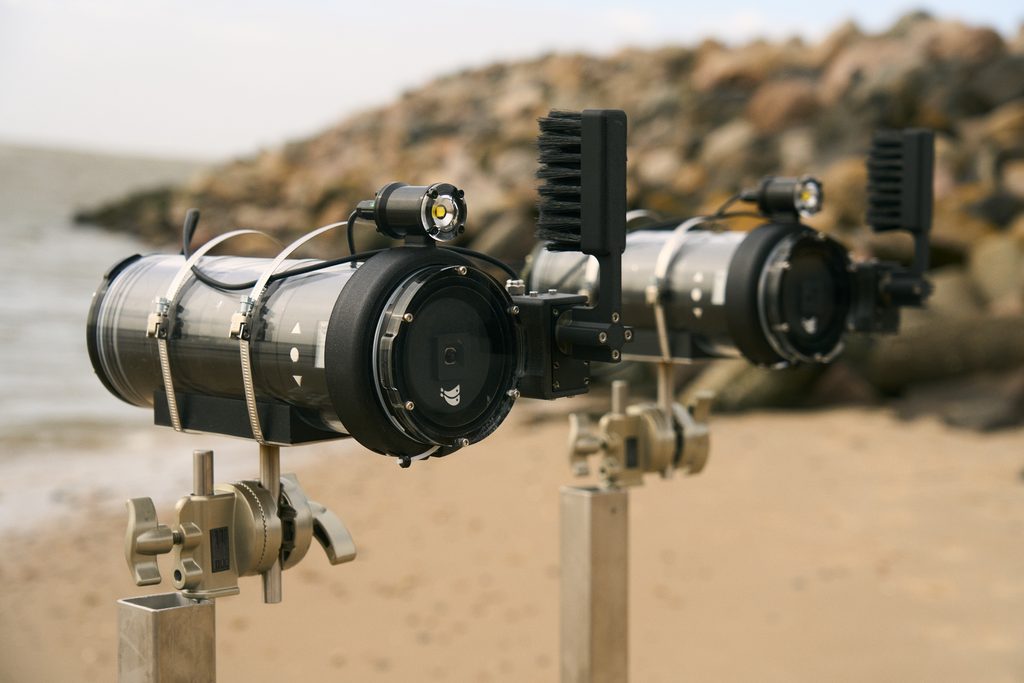
The project is therefore not only about developing a new camera. It is also about creating a new way of monitoring changes in marine ecosystems. By adapting the NDVI principle to underwater conditions, Anemo Robotics could make continuous monitoring of marine vegetation more systematic and data-driven.
The collaboration with NIOZ has been strengthened through the project, and the partner has expressed interest in continuing the cooperation. This includes the potential purchase of additional NDVI cameras as well as new projects within areas such as seabird monitoring and tree reefs. At the same time, the collaboration creates opportunities for greater international visibility through NIOZ’s network.
The COO of Anemo Robotics stated:
“CLEAN’s International Innovation Pilot let us validate our technology developments with a leading research institute before committing to a full development. That single step has helped turn the relationship into a partnership, where NIOZ is now one of our key customers with two big projects ahead of us.”
CO₂ as a Tool to Give Textiles a New Life
At GLYON, CO₂ is actively used in a catalytic process for textile recycling.
At Brightlands Chemelot Campus in the Netherlands, the project has given GLYON the opportunity to work on scaling up the technology and testing it under more industrial conditions. The focus has included the quality of the recovered materials, while the project has also generated concrete commercial progress.
GLYON has signed a letter of intent with Textile Pioneers to initiate product testing. At the same time, the work at Brightlands has identified a potential new market within specialty chemicals, which could provide GLYON with a faster route to market and potentially broaden its business opportunities.
In addition, GLYON has entered into dialogue with two venture capital funds and a business angel regarding financing for the next stage of scale-up. The project has therefore not only contributed to the technical development of the technology, but has also created new market opportunities as well as concrete commercial and investor interest.
The CEO of GLYON stated:
“The International Innovation Pilot has been an accelerator for GLYON – it helped us push our technical scale-up forward, expand our engagement with textile sorters, fiber producers, and chemical industry players, and start building the strategic partnerships we need to prepare for industrial deployment. It’s been helpful support for the validation a deep tech company at our stage needs.”
Laser Robot Attracts Global Industrial Interest
ASEA is developing a battery-powered robot that uses laser technology for industrial cleaning and surface treatment. The technology is designed to replace conventional processes in which chemicals and abrasives often play a central role.
In collaboration with HAITCH Ltd. in China, the robot has been tested for industrial applications where high precision and consistent surface treatment are essential. The solution has the potential to both shorten cleaning processes and reduce the use of chemicals and other materials.
ENVISION ENERGY has expressed an interest in implementing the ASEA Laser Robot across its 28 production sites globally. At the same time, Vestas, Siemens Gamesa, Nordex and Enercon have shown technical and commercial interest, and discussions are ongoing regarding potential pilot projects.
The interest extends beyond the wind industry. The technology has also attracted attention from the maritime sector, railways, aerospace and heavy manufacturing, where laser-based cleaning could provide an alternative to conventional chemical-based methods. According to the project material, the total commercial pipeline is estimated at more than EUR 20 million within the first two years after market introduction, with additional potential through licensing and system integration.
The project has therefore helped move the ASEA Laser Robot from a technological solution to a concept with concrete global market interest.
Seven Other Companies Took Their Technologies to International Markets
Flow Minerals is working with Ocean Limestone, an electrochemical system that removes CO₂ from seawater while simultaneously producing calcium carbonate. The project has explored opportunities for a pilot facility in Norway and identified both potential customers and partners interested in fossil-free lime.
Drink Lumi is developing a compact water filter designed for direct installation on a tap. Together with Shenzhen Hidly Water Purification Technology and the Danish Technological Institute, the company is working on a new membrane intended to improve filtration efficiency and make the solution suitable for different water qualities and markets.
STAC Technology is collaborating with Alfa Laval on CARA Cooling technology, which uses excess heat as an energy source for cooling. The collaboration combines the technology with Alfa Laval’s industrial expertise, knowledge and components, bringing the solution closer to large-scale application.
BAIONYX is developing a modular filter that captures microplastics and other small particles from road runoff before they reach the aquatic environment. The project has explored the solution in a Nordic context and generated data and relationships intended to support concrete Scandinavian pilot projects and a focused go-to-market effort in 2026.
E-CIP Concept has used its Danish experience with reusing rinse water in industrial cleaning processes as a basis for exploring new export markets. Collaboration with the Danish Embassy in Stockholm has contributed to new relationships and a stronger foundation for a flexible go-to-market strategy, leaving the company better positioned to focus on one or two export markets in 2026.
ReefCircular, together with WSP, has worked with nature-inclusive artificial reefs for offshore infrastructure. The project has led directly to a collaboration with WSP UK & Ireland, and the partners are now preparing a proposal for Vattenfall with a view to a potential commercial offshore project involving artificial reefs.
PEATZ has explored opportunities to introduce its digital technology for wetland restoration to the German market. The project showed that Germany offers significant long-term potential, but also that market entry will require additional resources. The result is therefore a stronger basis for PEATZ’s future international scaling, along with valuable relationships with ZukunftMoor and other German stakeholders.
International Pilots Provide More Than Market Access
A common thread across the 10 projects is that internationalisation is not only about finding a new customer.
It is also about understanding how a technology performs under different conditions, identifying the partners that can help take it further, and assessing whether a market is actually the right next step.
For some companies, the pilot projects have led to concrete customer and investor dialogues. For others, they have opened up new application areas, strengthened international partnerships or provided valuable insights into where and how the company should scale.
And that is precisely the value of testing early. Sometimes, a pilot confirms the path a company was already planning to take. At other times, it opens the door to an opportunity that was not visible at the outset.