Cooling buildings, data centers, and industrial processes requires large amounts of energy. At the same time, enormous amounts of excess heat are lost every day, even though in many cases this energy could be used to generate cooling. This creates a need for new solutions that can utilize the energy more efficiently.
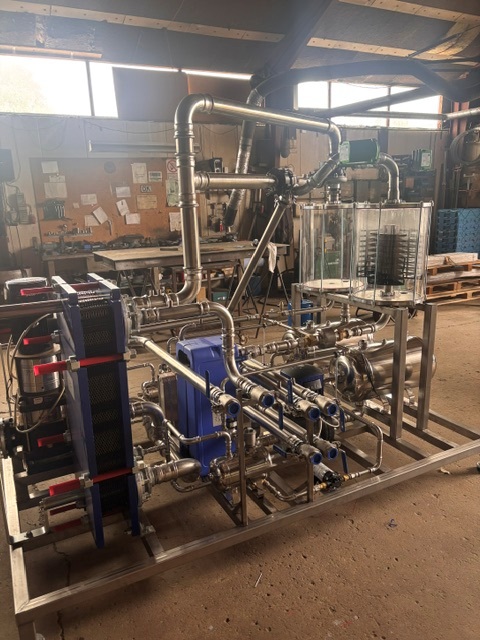
Heat-driven water-based cooling technology is an innovation project in which CARA Cooling is further developing a cooling solution that utilizes excess heat to produce cooling. Instead of traditional refrigerants, the system uses only water as both the working fluid and the refrigerant. The goal is to develop a flexible and modular cooling technology that can reduce energy consumption and make it easier to utilize excess heat in both buildings and industrial processes.
Cooling with Water and Waste Heat
The project aims to develop a modular cooling system that can be adapted to various heat sources, such as water vapor or hot oil. At the same time, the system must be capable of providing cooling for a variety of applications—from building cooling and data centers to industrial processes and CO₂ capture.
Most of the system’s components are based on well-known industrial components, while the individual modules can be adapted to the specific application. The goal is to develop a flexible platform that can be used across different industries and for a variety of needs.
From Prototype to Industrial Application
The project is being carried out by CARA Cooling ApS in collaboration with DTU Wind, DTU Electro, and Randbøldal VVS ApS.
The project involves the development and testing of the cooling solution using various heat sources and under conditions that reflect real-world industrial applications. At the same time, the system’s control mechanisms, sensors, and thermodynamic models are being further developed to document the technology’s performance and support the solution’s continued development.
The goal is to further develop the technology and document its application under conditions that reflect various industrial needs.
Development and Testing at Risø
The project is being carried out at Risø, where the cooling system is being installed and tested in PowerLab. Researchers from DTU Wind are contributing to the testing of the cooling and heating system, while DTU Electro is developing a speckle-based sensor to control the turbo compressor.
CARA Cooling is also affiliated with DTU Link at Risø, where the company has its development and testing facilities. This collaboration provides access to research expertise and testing environments that are essential for the project’s further development.
Part of the Risø SME Innovation Platform
The project is one of 15 innovation projects within the Risø SME Innovation Platform, where companies and research institutions collaborate to develop and demonstrate new green technologies. The platform provides companies with access to research expertise, testing facilities, and strong innovation partnerships based at Risø.
Explore the other projects on the innovation platform
- PFASOL – PFAS in solar power plants – mapping and documentation of PFAS in solar power plants.
- OmniPFAS – flexible solutions for removing PFAS from various types of water.
- KhaosGuard – continuous monitoring of nitrous oxide emissions from wastewater treatment plants.
- RisøLith – 3D printing at the nanoscale at low temperatures.
- Circular solar-powered lighting – off-grid lighting with a focus on circularity and dark-sky principles.
- Heat-driven water-based cooling technology – utilization of excess heat for energy-efficient cooling.
- Reliable water supply – mobile solutions for producing safe drinking water.
- Searine M360 – electric propulsion system for small boats.
- Chemical plastic recycling – conversion of plastic waste into methanol.
- NanoShield – UV and nanotechnology that inhibits bacterial and algal growth on metal surfaces.
- Lab2Land – Greenlandic rock flour for carbon sequestration and soil improvement.
- 3D printing for flood protection – nature-based barriers printed directly into the landscape.
- Recycled Wind Turbines for 3D-Printed Homes – fiberglass from end-of-life wind turbines as a building material.
- Circular Plastic without Permanence – biodegradable plastic made from brewery waste.
- Circular Battery Design – battery systems designed for disassembly, repair, and reuse.
The project is part of the Risø SME Innovation Platform, which was developed as a coordinated initiative under the Investment Support Scheme for Green Innovative Technologies and is administered by Clean. The initiative is funded by REACT-EU funds administered by the Danish Board of Business Development.